

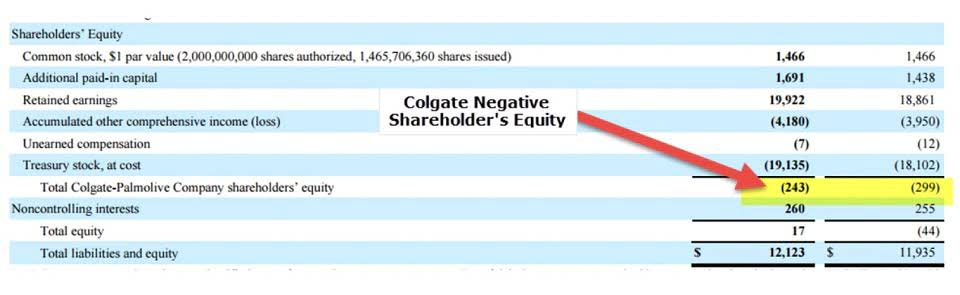
Some businesses, especially early-stage or tech-focused ones, can have low or even negative equity and still do well. Because they’re built on ideas or intellectual property, not physical assets. Things like brand reputation, customer loyalty, or future potential don’t show up in the numbers. And in some industries, those can be worth more than the assets on the books. There is a clear distinction between the book value of equity recorded on the balance sheet and the market value of equity according to the publicly traded stock market. The “Treasury Stock” line item refers to shares previously issued by the company that were later repurchased in the open market or directly from shareholders.
The Stockholder’s Equity Section of the Balance Sheet
- Generally speaking, the par value of common stock is minimal and has no economic significance.
- This and other summary accounts can be thought of as a clearing account.
- On the other hand, Total Liabilities include both current obligations, like accounts payable, and long-term obligations, such as bonds payable.
- This transparency helps maintain investor confidence and facilitates informed decision-making.
- Issuing new shares increases shareholder equity by raising additional capital, which is reflected in the common stock and additional paid-in capital accounts.
This in depth view of equity is best demonstrated in the expanded accounting equation. This transparency helps in understanding the companys ability to generate profits, manage debts, and distribute dividends, How to Invoice as a Freelancer thereby influencing investment choices and market perceptions. Regular and consistent reporting of shareholder equity aids in maintaining regulatory compliance and upholding investor confidence. Accounting for shareholder equity in public companies is a crucial aspect of financial management and reporting. Shareholder equity represents the owners’ claim after all liabilities have been settled, reflecting the net assets owned by the shareholders. This component is essential for investors as it provides insight into the company’s financial health and long-term viability.
- Some valuable items that cannot be measured and expressed in dollars include the company’s outstanding reputation, its customer base, the value of successful consumer brands, and its management team.
- For businesses and investors alike, stockholders’ equity is one of the key answers.
- Typically, a preferred stock will pay a dividend, but preferred stockholders typically have no voting rights in the company.
- This financial document transparently provides investors with crucial information about their equity value.
- The statement of stockholders’ equity outlines changes in ownership and capital structure over a reporting period.
- These are not yet distributed to the stockholders and retained by the company for investing in the business.
Shareholders equity calculation example
It represents what’s left for shareholders after all company debts are paid. The second formula (Common Shares + Preferred Shares + Paid-In Capital + Retained Earnings) breaks normal balance down the components that make up SE, showing its sources of funding and accumulated profits. Retained earnings represent the cumulative net income of a corporation that has been retained rather than distributed to shareholders as dividends. These earnings are reinvested in the business to expand operations, purchase new equipment, or pay off debt. Preferred stockholders have a higher claim on the company’s total assets and earnings compared to common stockholders, but rank below bondholders in priority. When a company buys back shares, it uses cash to repurchase them, which reduces both cash (an asset) and stockholders’ equity.
What is preferred stock?

Accurate reporting ensures transparency and helps maintain investor confidence, which is vital for the company’s reputation and market value. Stockholders’ equity statements are crucial financial documents that provide insights into a company’s ownership structure and capital changes over time. These statements reflect the equity portion of the balance sheet, detailing how equity capital is built up through common stock, preferred stock, retained earnings, and additional paid-in capital.
The preference stock enjoys a higher claim in the company’s earnings and assets than the common stockholders. They will be entitled to dividend payments before the common stockholders receive theirs. Stockholders’ equity is the company that has settled the value of assets available to the shareholders after all liabilities. It provides information relating to equity-related activity to the users of financial statements and it is one of the financial elements used by analysts to understand the company’s financial progress. Shareholders’ equity is the value of the company’s obligation to shareholders. It appears on a company’s balance sheet, along with assets and liabilities.
In case of liquidation, common stockholders will be paid only after settling the outside liabilities, then bondholders and preference shareholders. Book value is the recorded value of statement of stockholders equity a company’s assets, whereas shareholders’ equity is the value of the assets minus liabilities. In contrast, the company’s cash flow statement provides information about the cash inflows and outflows of a company, detailing how cash is generated and used during a specific period. Statement of stockholder’s equity, often called the statement of changes in equity, is one of four general purpose financial statements and is the second financial statement prepared in the accounting cycle. This statement displays how equity changes from the beginning of an accounting period to the end.

- This component reflects the additional funds contributed by shareholders beyond the nominal value of the shares.
- It provides detailed information about the changes in the value of shareholders’ equity or ownership interest in a company over a specific accounting period.
- Shareholder equity represents the owners’ claim after all liabilities have been settled, and it is a key indicator of a company’s financial health.
- For private entities, the market mechanism does not exist, so other valuation forms must be used to estimate value.
However, the stockholders’ claim comes after the liabilities have been paid. Aside from the ROE ratio, shareholders’ equity is also used to calculate ratios like the book value of equity per share (BVPS) and debt-to-equity ratio (D/E). In a more simple term, it is the remains of the company after all its liabilities have been separated from its assets. It represents the company’s net worth and the amount that will be given to shareholders of the company if all its assets are to be liquidated and all its debt settled.